Introduction
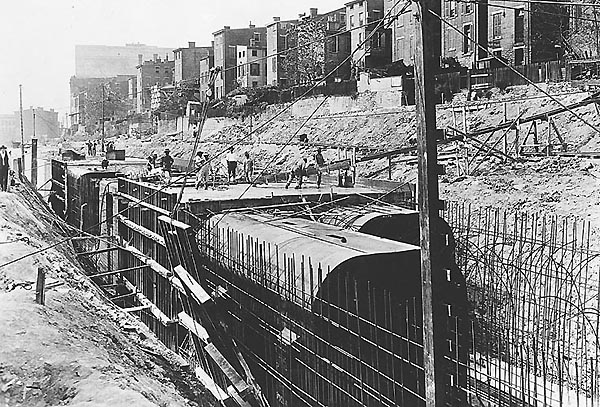
Abandoned tunnels are often the object of urban legend,but Cincinnati is in fact the site of the country's largest abandonedsubwaytunnel. But "abandoned" is not quite the word, as constructionslowedto a stop in 1925 before even half of the 16 mile line wascompleted. Seven miles between Cincinnati's central business district and theindustrialsuburb of Norwood were tunneled, bridged, or graded, but no track waslaidand no subway cars were ordered. No passengers ever rode betweenthe six stations that were built.
The incompleteCincinnatiline sat fallow through the Great Depression and WWII. Bridges,stations,and retaining walls along the surface stretches deteriorated to such anextent that a few items actually collapsed. Nearly everythingabove ground wasbulldozed to make way for portions of I-75 and the Norwood Lateral inthe1950's and 1970's, respectively. The mute two mile tunnel that remainsunder Central Parkway is unknown to many Cincinnati natives, and whatmostwho do know of it know consists largely of hearsay andspeculation.
This page is the most comprehensive and mostaccuratesource of information regarding the subway either on the web or inprint. It is by far the most popular subject on www.cincinnati-transit.net,and tens of thousands have visited it since its appearance in 1999.
Subway F.A.Q.
1. Where is the subway?
The main subway tunnel runs under Central Parkway for two miles,betweenWalnut St. and an anonymous spot north of the Western HillsViaduct. Three underground stations were built and still exist at Race St.,Liberty St., andBrighton's Corner. An extension of this tunnel under Walnut St.souththrough downtown with a station at Fountain Square was planned butneverbuilt. Additionally, several miles of surface running line weregradedand three of roughly a dozen planned above ground stations werebuilt. Significant portions of today's I-75 and the Norwood Lateral follow thepath of the line. A stretch of I-71 near the Dana Ave.interchange was built where the subway loop's eastern half was planned.
2. When was it constructed?
1920 through 1925. The $6 million bond issue in 1916 wasexhaustedin 1925, no further money was obtained, and construction never resumed.
3. Can the tunnel still be used?
Yes. It has been continuously maintained and will likely beusablefor the next hundred years, if not longer. The 2002 "Metro Moves"sales tax wouldhavefunded a rail transit network that planned to use the tunnel, but itwasdefeated by a 2-1 public vote.
Section1 Planning and construction
Section2 Completion attempts
Section3 The subway today
Section4 Various proposals
Section5 What might have been
Section6 Future use
ConstructionPhotos
PortalPhotos
BrightonStation Photos
LinnSt. Station Photos
LibertySt. Station Photos
RaceSt. Station Photos
HoppleSt. Tunnel
NorwoodTunnels
1950'sPhoto Tour
EarlySubway Plans and Diagrams
SubwayMaps