About 10 minutes before the implosion -- the sun is behind theSuspension Bridge's tower.
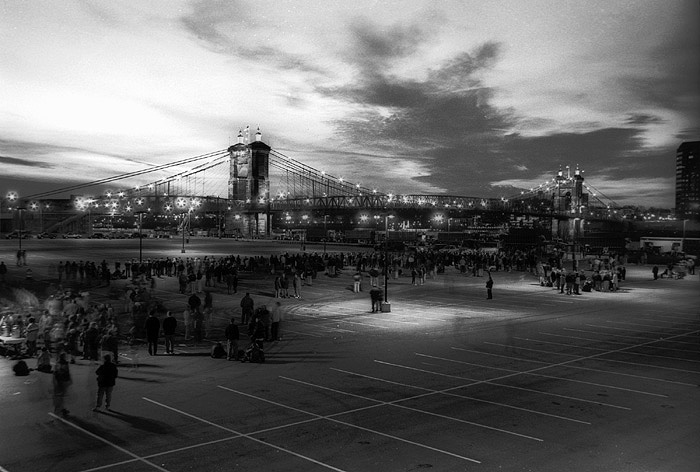
Relatively few people watched the implosion from the westernriverfront. From where I was on Elm St. adjacent to the Paul BrownStadium plaza, there were no more than 5,000 people and probably fewerthan that. The group I was with hurried down to the riverfront at6:30, presuming the crowd to have already claimed the best spots. But even up until the moment of the implosion, there were still open spotsalong the Elm St. railing.
Those who were in place at 7:00am were treated to a spectacularsunrise (pictured above), centered perfectly above the Suspension Bridgefrom our angle. Packs of young kids ran around and chants rose outof the crowd at times, but the early hour and 30F cold kept things fromgetting rowdy.
About 10 minutes before the implosion -- the sun is behind theSuspension Bridge's tower.
After so much anticipation, the implosion came about quitesuddenly. There was no visible or audible official time clock, untilthe Paul Brown Stadium P.A. clicked on with the countdown, starting at8 seconds. Having never witnessed an implosion, I and probably mostothers anticipated a deep mortar shell sound to the charges, but it wasinstead a high pitched gun shot type of sound. The charges couldbe heard in perfect rhythm coming counter-clockwise from the east sideof the stadium, and as they passed along the visible west side of the stadium,brief flashes could be seen. Nothing started falling until a secondwave of charges about 15 seconds later, at which point the stadium fellin on itself in a counter-clockwise wave. Again, the sound was differentthan I anticipated. I braced for an earth-shaking rumble, but therewasn't any ground vibration, and there was none of the chest-thumping froma large fireworks display. The sound of such a large structure collapsingwasn't very loud, nor was it particularly distinct. There was noshockwave of wind or dust.
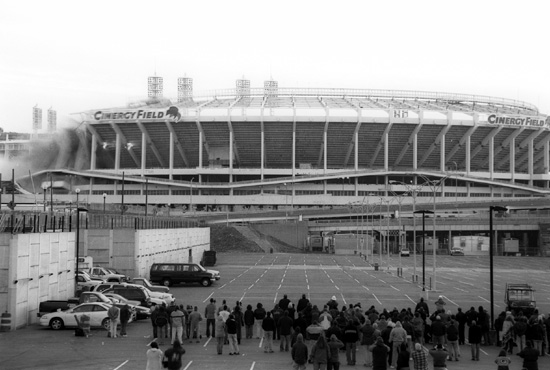

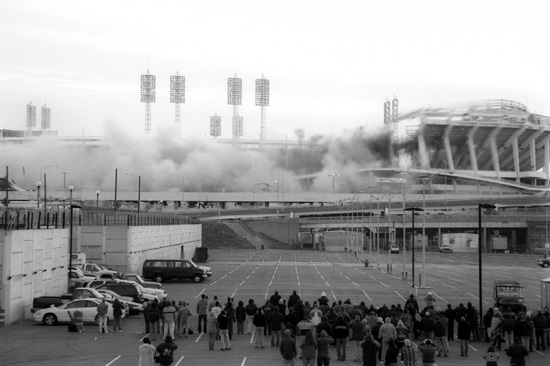
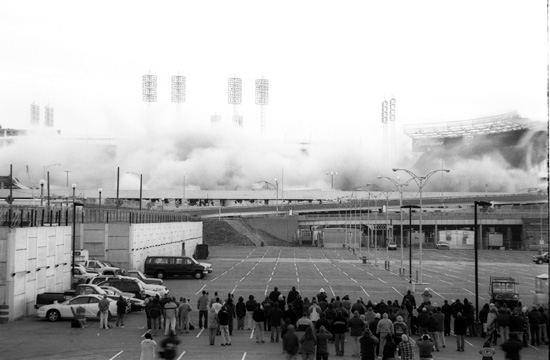
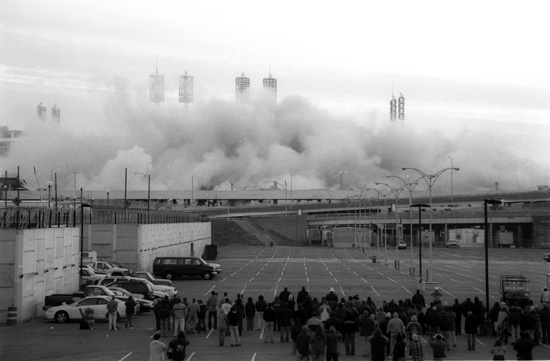

After the implosion, a large dust cloud rose from thesite and drifted lazily north towards the downtown business district. Within 10 minutes, it enveloped the entire front of the business district,up to the 20th floor of office buildings. It hung around for another10 minutes, casting an apocalyptic haze over the deserted city streets,and Ft. Washington Way, which had been closed as well.
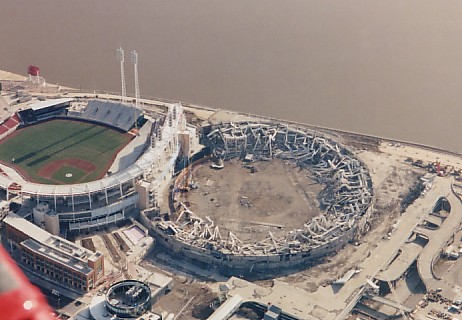
ClickHere for aerial photos taken after the implosion
ClickHere for March 2003 photos of the implosionsite and new Great American Ballpark
ClickHere for miscellaneous photos of the stadium 1999-2002